


Your shopping cart is empty!
Pumpkin "Flynn" F1
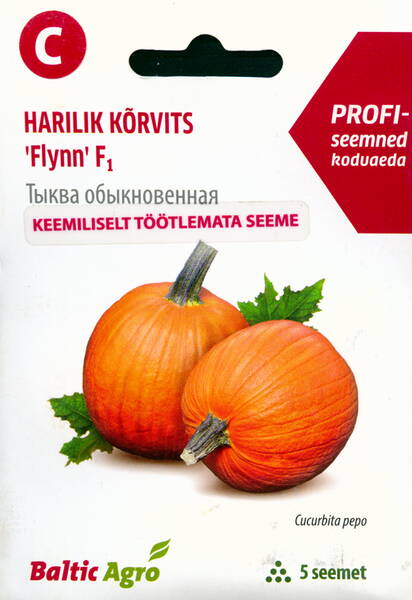
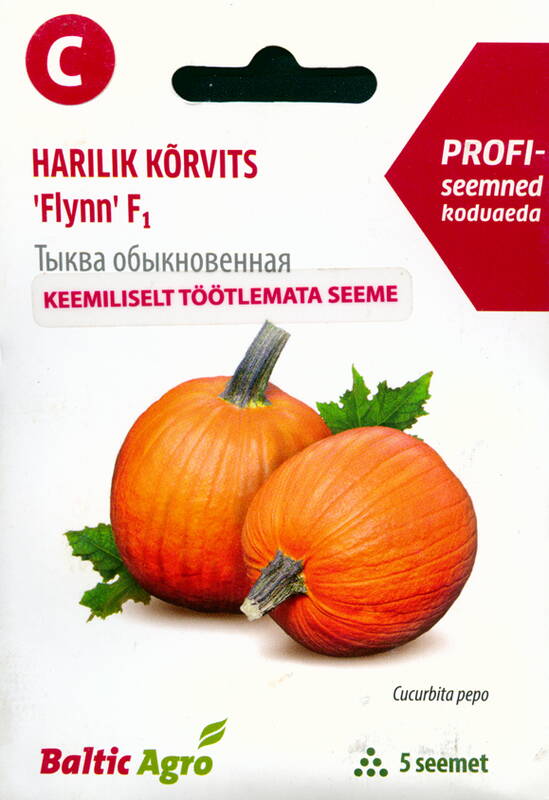
Pumpkin "Flynn" F1.
Great for healthy cooking—and also for Halloween crafts.
Cold-tolerant, high-yield table variety. Fruits are round, moderately ribbed, weighing 3–3.8 kg and 20–22 cm in diameter.
Flesh is excellent: bright orange, crisp, very aromatic, with increased carotene and sugar content. Nutritional and dietary value is high.
The variety is highly transportable, stores very well, and is disease-resistant.
Direct sowing outdoors: late May to early June (2–3 seeds per hole, 5–6 cm deep, 70 cm between holes). Thin after emergence.
Can also be grown as seedlings: transplant 20-day-old seedlings outdoors once the risk of frost has passed. Pinch the main stem above the 4th leaf; leave 1–2 fruits on side shoots.
Planting pattern: 70 x 70 cm.
For strong growth and abundant yields, provide timely watering, regular weeding, loosening, and mineral fertiliser feeding.
Great for healthy cooking—and also for Halloween crafts.
Cold-tolerant, high-yield table variety. Fruits are round, moderately ribbed, weighing 3–3.8 kg and 20–22 cm in diameter.
Flesh is excellent: bright orange, crisp, very aromatic, with increased carotene and sugar content. Nutritional and dietary value is high.
The variety is highly transportable, stores very well, and is disease-resistant.
Direct sowing outdoors: late May to early June (2–3 seeds per hole, 5–6 cm deep, 70 cm between holes). Thin after emergence.
Can also be grown as seedlings: transplant 20-day-old seedlings outdoors once the risk of frost has passed. Pinch the main stem above the 4th leaf; leave 1–2 fruits on side shoots.
Planting pattern: 70 x 70 cm.
For strong growth and abundant yields, provide timely watering, regular weeding, loosening, and mineral fertiliser feeding.
Growing.
Pumpkin has similar requirements to cucumber in open field, but it is more tolerant of adverse conditions, especially cooler temperatures, and is therefore better suited to outdoor growing. Pollen germination and growth occur at lower temperatures than in cucumber (+14…+15°C) and melon (+18°C). Warm weather and good moisture supply favour growth, and pumpkin can go without irrigation longer than cucumber. Because of sensitivity to wind, pumpkin is often recommended to be grown between maize plants. Pumpkin prefers loose, humus-rich soils and responds well to organic fertilisers.
Pumpkin does not tolerate repeated cultivation after other cucurbits—this should also be considered when growing on compost heaps. Earlier harvests can be achieved by raising transplants in greenhouses. Sow 2–3 seeds in 10 cm pots, 2–3 cm deep. Seeds germinate at +15…+20°C. Then maintain +18/+14°C (day/night). After 3 weeks, seedlings have 2 leaves and are ready for planting. Harden plants to improve resistance to low temperatures. Transplant in mid-May when night frost risk has passed. Plant density: for zucchini-type growth 0.5–1 plant per 1 m²; for trailing pumpkins reduce to 0.3 plant per 1 m². Cultivation on mulching film is effective; in that case direct sowing is also possible.
Care is mainly shallow, repeated loosening. Toward the end of the season, weed control may be needed (hand weeding). No special pruning is required. Pest and disease control is usually secondary; the main risks are viral diseases (control of vectors is needed) and late-season powdery mildew.
Harvest and storage.
Harvest before the first frosts once fully mature. Leave a stem about 10 cm long. Depending on productivity (on average 4–5 fruits per plant), harvest heavier or lighter individual fruits. Some fruits can reach 120 kg, and yields can exceed 1000 centners/ha. Pumpkins can be stored for several weeks to several months. Optimal temperature for the first two weeks is +24…+30°C—during this time fruits finish ripening and the rind hardens. Then reduce storage temperature to +10…+13°C.
Pickled pumpkin.
Ingredients:
• 650 g pumpkin;
• 150 g sugar;
• 200 g water;
• 2 tbsp 9% vinegar (or 1/2 tsp citric acid);
• 3–4 cloves;
• 1/4 tsp cinnamon.
Method:
1. Peel the pumpkin and cut into cubes.
2. Blanch in boiling water for 3–4 minutes, then cool in cold water for 2–3 minutes.
3. Pack into a 1-litre jar, add cinnamon and cloves.
4. Make the marinade (boil 200 g water with 150 g sugar for 10 minutes).
5. Remove from heat, add vinegar or citric acid, stir, pour over the pumpkin and close with a lid.
6. Turn the jar upside down onto the lid and cool under a blanket.
Store in a cool place.